
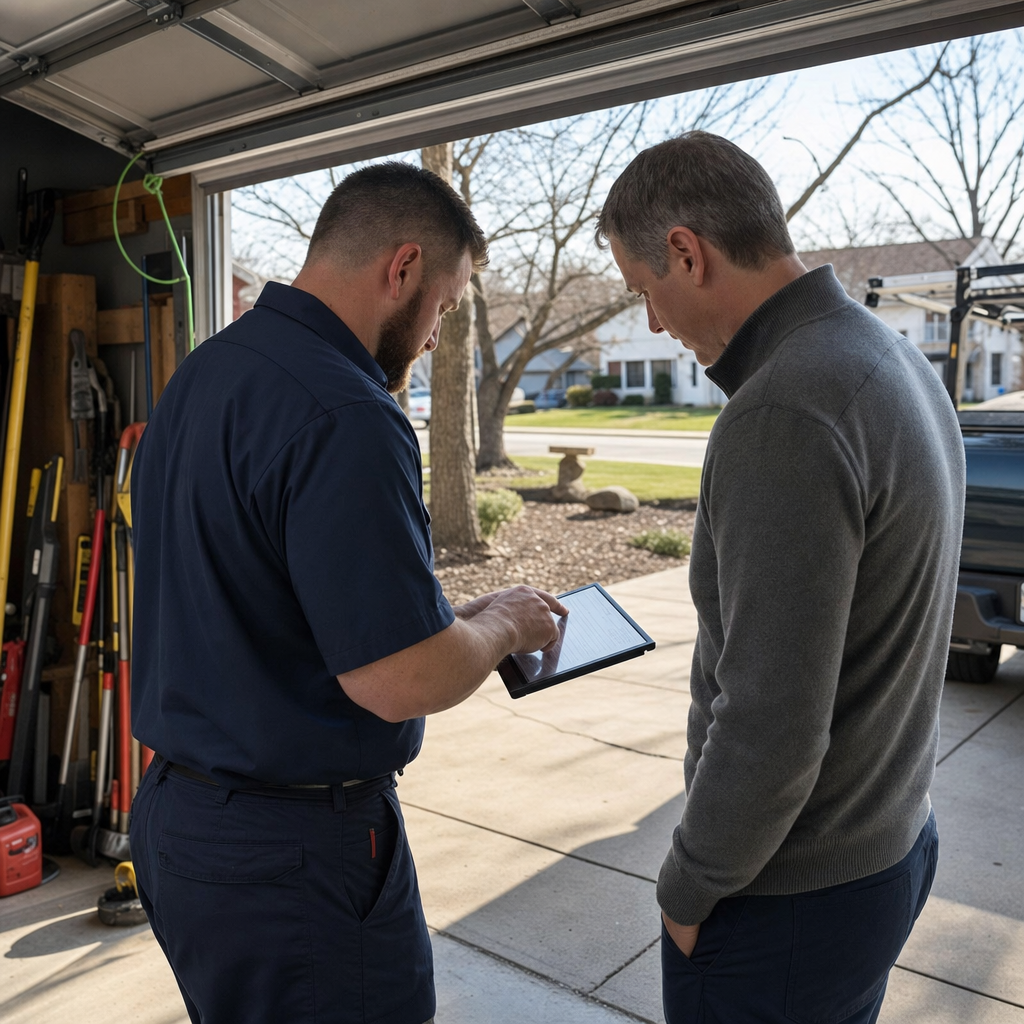
Garage Door Opener Installation in Cleveland, OH — $250–$550 with Same-Day Measurement
Garage Door Opener Near Me in Cleveland, OH typically runs $250–$550 depending on opener type, header clearance, and whether your garage needs electrical work. Most standard belt-drive installs on post-WWII ranch homes fall in the $300–$450 range, while low-headroom conversions or jackshaft installs in older Cleveland Heights and Tremont alley garages push toward the upper end. Call (855) 502-5513 for a free, on-site measurement — we stock the hardware for both scenarios and can usually install within 24–48 hours.
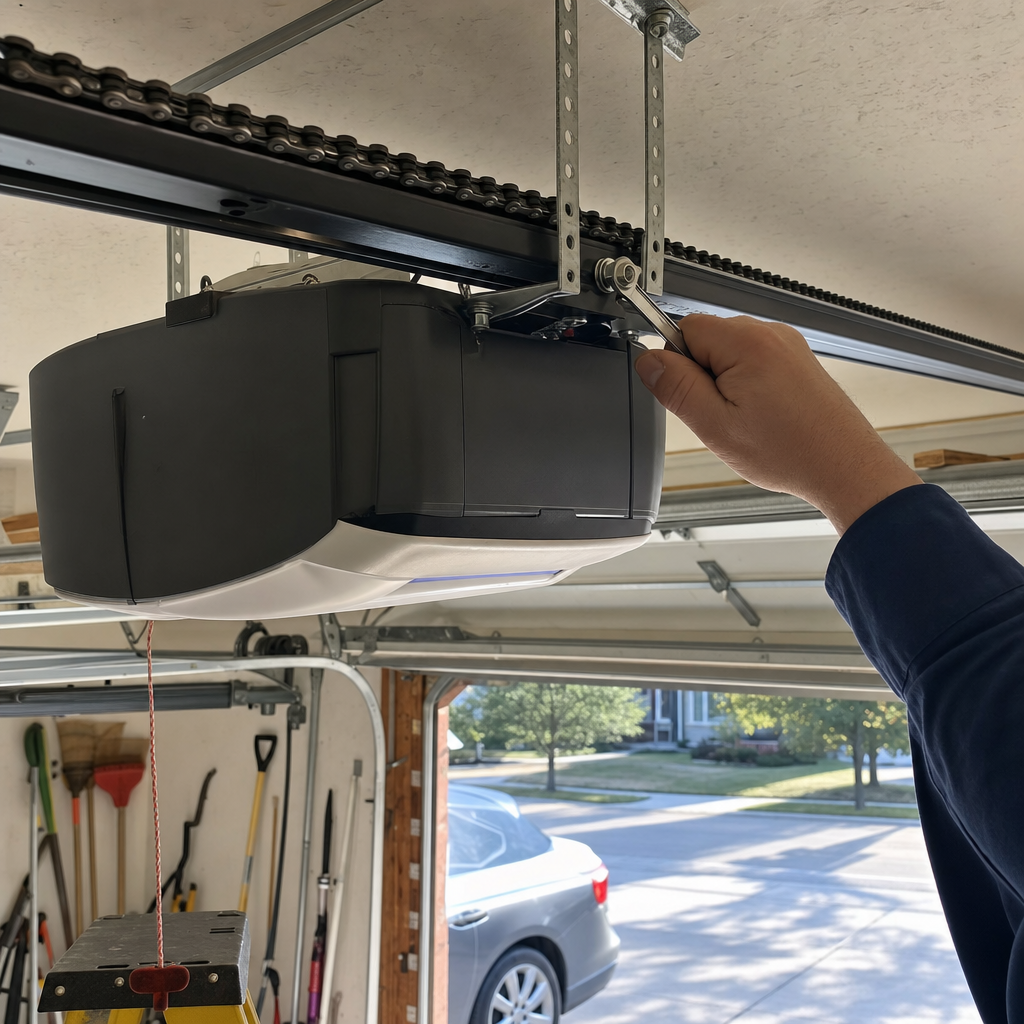
Here’s the reality we’ve learned after 14 years of working across Greater Cleveland: this job isn’t a simple swap. The installer who treats every garage like a blank slate is the one who shows up with a standard rail-drive LiftMaster, measures your header after it’s unboxed, and realizes you’ve got six inches too little headroom. We’ve rescued too many half-finished jobs from that scenario. Richard Anderson, our owner and lead technician, measures first — every single time — because Cleveland’s housing stock demands it.
Why Cleveland Garages Break the Standard Opener Playbook
Most opener manufacturers design around a 10–12 inch headroom assumption. That’s fine in Phoenix subdivisions. It’s not fine in Ohio City, West Park, or Detroit-Shoreway, where we regularly walk into alley garages built in the 1920s with headers sitting at 6’6″ or 6’8″. A standard trolley-drive opener needs its rail mounted above the door’s highest travel point, plus clearance for the motor housing. When that space doesn’t exist, you’ve got three options — and only two of them actually work.
The wrong option: forcing a standard install and watching the door bind, jump track, or destroy the opener gear within months. We’ve replaced openers installed this way by other companies. It’s never pretty.
The right options depend on your garage’s specifics:
- Low-headroom conversion kit — modifies the track geometry and uses a specialized trolley to compress the rail profile. Works when you’ve got 4–6 inches of headroom and a standard ceiling mount is possible. We stock these for LiftMaster and Chamberlain systems.
- Wall-mount jackshaft opener — mounts beside the door on the torsion tube, eliminating the rail entirely. Required when headroom is under 4 inches or the ceiling is obstructed by ductwork, beams, or a finished loft. LiftMaster’s 8500W series and Genie’s Wall Mount are our go-to units here.
- Standard belt or chain drive — only viable when you’ve got 10+ inches of clean headroom. Fits most Parma, Garfield Heights, and Euclid ranch garages built 1950–1970.
In Tremont last March, we quoted a job where the previous installer had sold a standard belt drive without measuring. The homeowner had a 6’7″ header and a concrete lintel he couldn’t modify. We swapped it for a jackshaft install in four hours. The other company had left him with an unreturnable opener in his basement and a door that wouldn’t cycle.
The Two Cleveland Garage Types — And What Each Needs
Pre-WWII Alley Garages: Ohio City, Tremont, Cleveland Heights, West Park
These garages were sized for Model A Fords, not F-150s. We see single-car openings as narrow as 7’6″ with header clearances that make standard opener rails impossible. The framing is often dimensional lumber that’s settled or twisted over a century. Electrical service, if it exists at all, may be a single 15-amp circuit shared with outdoor outlets.
For these, we spec jackshaft openers almost exclusively. The LiftMaster 8500W or Genie Wall Mount free up ceiling space, eliminate rail interference, and mount directly to the torsion hardware. They require a 120V outlet within 6 feet of the motor — if yours isn’t there, we run the circuit as part of the install, not as a surprise add-on later.
One detail competitors miss: jackshaft openers need a torsion spring system in good condition. Extension-spring doors common in 1920s construction require conversion to torsion before a jackshaft will work. Richard flags this during measurement, not during installation. We’ve walked away from jobs where the spring system was too deteriorated to safely support a jackshaft, explained why, and been called back after the homeowner had the springs replaced.
Post-WWII Ranch Garages: Parma, Garfield Heights, Euclid, Strongsville
These attached two-car garages usually have adequate headroom — 8 to 9-foot ceilings with standard gable or hip roofs. Here, a belt-drive opener like the Chamberlain B6753T or LiftMaster 87504-267 is typically the right call. Quieter than chain drives, reliable for 10–15 years, and compatible with modern smart-home integration.
The catch in these neighborhoods isn’t headroom. It’s age. These garages are 60–70 years old. Original wiring may be ungrounded 2-wire Romex. The garage door itself may have original Wayne Dalton or Raynor hardware that’s been patched together for decades. We check the door’s balance, spring condition, and track alignment before mounting any opener — because a new motor on a binding, unbalanced door is a warranty claim waiting to happen.
In Parma, where Richard grew up, we see this constantly. The door “worked fine” with the old opener because a weak 1/3-horsepower motor was too underpowered to reveal the binding. Install a modern 3/4-horsepower unit with force-sensing safety features, and it detects the resistance and reverses — or burns out trying. We fix the door first, then install the opener. It’s the only way that lasts.
Lake-Effect Winters: Why Motor Torque Matters in Cleveland
Cleveland’s 60-plus inches of annual lake-effect snow isn’t just a shoveling problem. It’s an opener-killer.
Here’s the mechanism: snow melts slightly against the warmed garage floor, refreezes overnight into ice, and bonds the rubber bottom seal to the concrete threshold. The next morning, the opener tries to lift a door that’s effectively glued shut. An undersized motor — 1/3 or 1/2 horsepower on a heavy wood door or insulated steel door — strains, overheats, and strips its nylon gear or burns its winding. We’ve replaced opener gears every February for fourteen years.
The fix is proper torque specification matched to door weight and local conditions. For Cleveland, we generally spec How to Program Garage Door Opener? (Cleveland, OH) instructions for your model.
| Door Type | Recommended HP | Typical Install Cost |
|---|---|---|
| Light single-layer steel (8×7 ft) | 1/2 HP | $250–$380 |
| Insulated steel or composite (8×7 ft) | 3/4 HP | $320–$480 |
| Heavy wood or oversized (16×7 ft or larger) | 1 HP | $400–$550 |
| Low-headroom jackshaft install | 3/4–1 HP | $450–$550 |
The 3/4-horsepower threshold matters. Below that, you’re gambling on mild winters. In a Cleveland January, that’s not a bet I’d take — and we’ve got the burned-out Craftsman and Genie motors in our scrap pile to prove it.
Road salt accelerates the other failure mode: corroded cables, hinges, and springs that increase door weight and friction over time. A door that balanced at 12 pounds when new might present 25 pounds to the opener after five Cleveland winters. We measure actual door weight and spring balance during every install quote. It’s why our opener installations outlast the typical 7-year replacement cycle by a meaningful margin.
What Our Installation Visit Actually Includes
We’ve heard the stories about big-box install crews: in and out in 45 minutes, opener mounted, remotes handed over, no safety-reversal test, no force-limit verification, no explanation of what was done. That’s not how we work.
Richard Anderson handles every install personally. Here’s what happens when you book with Landmark:
- On-site measurement and clearance check — header height, side-room, back-room, electrical access. We verify the opener model we spec will actually fit before any hardware leaves the truck.
- Door balance and hardware inspection — spring tension, cable condition, roller and hinge wear, track alignment. If the door’s not right, we quote the repair separately and explain why the opener install depends on it.
- Electrical verification — grounded outlet within reach, circuit capacity, GFI protection where required. We don’t hardwire into knob-and-tube or overload shared circuits.
- Opener mounting and rail assembly — lag-bolted to structural framing, not drywall or thin furring strips. Proper rail angle for smooth trolley travel.
- Safety system installation and testing — photo-eye alignment at 6 inches from floor (per current standards), force-limit calibration, auto-reverse verification with 2×4 obstruction test.
- Remote and keypad programming — two remotes standard, wireless keypad if requested, MyQ or equivalent smart-home setup if the opener supports it.
- Walkthrough and documentation — we show you the emergency release, explain the maintenance points, and leave written specs for your records.
Typical install time: 2.5 to 4 hours depending on electrical work and whether we’re converting from extension to torsion springs. We don’t schedule three jobs in a morning and rush through yours. Richard’s daughter’s softball schedule keeps our weekends honest — we run tight during the week because we don’t waste anyone’s time.
I show up, I fix it right, and I tell you what I actually found — not what makes the invoice look bigger. For a Best Garage Door Opener in Cleveland, OH, trust our expertise.
Brand Matching: Why Our 8-Brand Fluency Saves You a Return Trip
We don’t sell one brand and force-fit it. Richard is trained and experienced across LiftMaster, Chamberlain, Genie, Craftsman, Raynor, Clopay, Amarr, and Wayne Dalton — which means we match the opener to your door and garage, not the other way around.
Raynor and Wayne Dalton doors, common in 1980s–90s Cleveland builds, sometimes use proprietary rail geometries or hinge spacing that interacts with opener mounting. A technician who’s only installed Chamberlains on standard 2-inch track may not catch the compatibility issue until the rail won’t line up. We’ve seen it. We plan for it.
Same with older Craftsman openers — Sears sold millions in the Midwest, and many Cleveland garages still have the original 1990s unit. When replacement time comes, the door hardware may be adapted to Craftsman’s specific trolley profile. We know which modern openers accept those adapters and which require full hardware replacement. It’s not guesswork if you’ve done it a hundred times.
When Opener Installation Becomes Opener Repair — And Vice Versa
Not every “opener won’t work” call needs a new unit. We’ve saved Cleveland homeowners hundreds by diagnosing stripped gears, failed circuit boards, or misaligned safety sensors that a less experienced tech would have declared unfixable.
Conversely, we’ve talked people out of repairing 15-year-old Genie screw-drive openers with discontinued parts and no safety features. The repair might cost $180. A new LiftMaster with battery backup, WiFi, and modern force-sensing runs $350 installed. The math isn’t hard, and we’ll walk you through it honestly.
Our Garage Door Opener service page covers repair scenarios in detail. For installs, the threshold is usually: unit over 12 years old, major component failure, or missing modern safety features. Everything else, we can evaluate.
FAQs
Garage door opener installation in Cleveland costs $250–$550, with most standard belt-drive installs on ranch-style garages falling between $300–$450. Jackshaft or low-headroom conversions in older homes with limited header clearance run $450–$550 due to specialized hardware and additional labor. Call (855) 502-5513 for a free, exact quote based on your garage’s measurements — estimates are free and carry no obligation.
Same-day installation is sometimes possible if your garage has standard clearances and we have your opener model in stock, but we typically schedule within 24–48 hours to allow proper measurement and material verification. For low-headroom or jackshaft installs in older Cleveland neighborhoods like Tremont or West Park, we measure first to confirm hardware specs — rushing this step is how botched installs happen. Call (855) 502-5513 and we’ll get you the earliest accurate appointment.
Repair is cheaper short-term — typically $120–$320 for common fixes like gear replacement, circuit board repair, or sensor realignment — but replacement makes more sense if your opener is over 12 years old, lacks modern safety auto-reverse, or uses discontinued parts. We evaluate both options honestly and won’t push replacement when repair is the smarter choice. Call (855) 502-5513 for a diagnostic and straight recommendation.
Yes — garages with headers under 7 feet typically need either a low-headroom conversion kit (for 4–6 inches of clearance) or a wall-mount jackshaft opener (for under 4 inches). Standard rail-drive openers require 10–12 inches and will not function safely in these spaces. We’ve installed both solutions across Cleveland Heights, Ohio City, and Detroit-Shoreway; the right choice depends on your exact clearance and spring system type. Call (855) 502-5513 for a measurement — we stock both options.
Ready for an Opener That Actually Fits Your Cleveland Garage?
Don’t let an installer learn your garage’s limitations on your dime. Richard Anderson measures first, specs the right opener for your header clearance and door weight, and installs it himself — 14 years of focused garage door work, 364 verified reviews averaging 4.9 stars, and zero subcontracted surprises. Call (855) 502-5513 today for a free estimate and same-week installation across Greater Cleveland.
Written by Richard Anderson, Owner & Lead Technician at Landmark Garage Door Installation Greater Cleveland, serving Cleveland, OH.